Subsurface ground movement across the Los Angeles Basin, combined with mature ficus and jacaranda root systems, causes joint dislocation in vitrified clay pipes throughout historical neighborhoods like Silver Lake, Los…
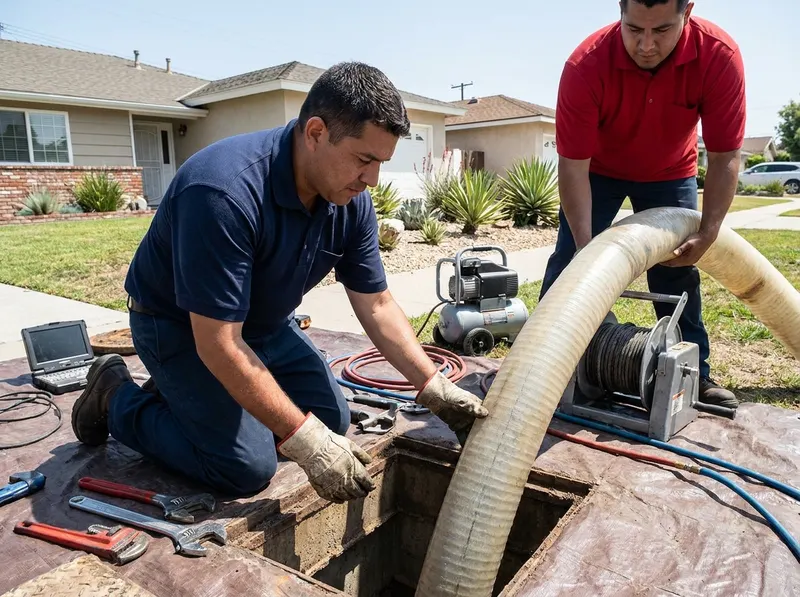
Subsurface ground movement across the Los Angeles Basin, combined with mature ficus and jacaranda root systems, causes joint dislocation in vitrified clay pipes throughout historical neighborhoods like Silver Lake, Los Feliz, and Highland Park. Trenchless cured-in-place sewer lining (CIPP) repairs compromised underground infrastructure by utilizing a single exterior cleanout access point. Technicians saturate a seamless non-woven felt tube with ambient-curing thermosetting epoxy resin, invert the tube through the host pipe via pressurized air, and inflate an internal bladder until the compound solidifies against the inner conduit walls. This creates a structural inner cylinder that reduces inner pipe diameter by less than 5 percent while increasing fluid velocity ratings. The minimum baseline service call starts at $200, which covers initial cleanout assessment and site line confirmation.
Selecting cured-in-place inversion resolves pipe deterioration beneath structural hardscapes where traditional open-trench excavation disrupts property access. In high-density settings throughout Koreatown or Echo Park, excavating a lateral pipe running beneath a concrete driveway, retaining wall, or mature landscaped parkway incurs substantial ancillary restoration costs. While traditional open-cut replacement completely removes fractured pipe, the excavation adds concrete demolition, street closure permitting through the Los Angeles Department of Public Works, and soil re-compaction fees. CIPP sidesteps excavation costs by preserving the surface, though it requires an existing host pipe that retains structural circularity; a fully collapsed host pipe where line capacity has flattened beyond 30 percent cannot host an inverted sleeve and requires targeted mechanical pipe-bursting or selective point excavation instead.
Permit guidelines enforced by the City of Los Angeles Department of Building and Safety (LADBS) and the Bureau of Sanitation specify that lateral lining within private property lines remains distinct from the public sewer main connection in the street. For hillside properties in Brentwood or Westwood, lining stabilizes aging sewer laterals resting on unstable terrain near Elysian Park or the Santa Monica Mountains without destabilizing surrounding subsoil. In flat coastal areas like Venice and valley sectors such as North Hollywood, sandy or shifting water tables accelerate pipe joint corrosion; structural epoxy seals these gaps entirely, blocking stormwater infiltration that overtaxes city treatment infrastructure. Initial field verification pinpoints physical access points, line distances, and turns prior to inversion.
Every job gets a firm, written price after a free on-site visit.
Tell us about your trenchless cured-in-place sewer lining job in los angeles and we'll send a clear, written quote, usually the same day.
 LA Property Helpers